On this page
Someone in a marketing meeting says, "We need an llms.txt, or AI won't find us." Someone else nods. Nobody's quite sure what it is, but it sounds important, and it sounds like something you'd be behind on. Let's slow down and look at what this file actually is, what it was designed to do, and what it honestly can and can't do for your site.
The short answer
llms.txt is a plain-text file, written in Markdown, that you put at /llms.txt on your website. It gives AI tools a short summary of your site and a list of the pages worth reading, with a note on each. Think of it as a hand-written table of contents for a reader that happens to be a language model.
It's a proposal, not an official standard. It was put forward by Jeremy Howard in September 2024, and the project's own site describes it as a proposal that's open to community input. No search engine has made it a requirement, and publishing one doesn't guarantee that any AI system will read it.
Why was it proposed?
Websites are built for people with browsers. A typical page has menus, cookie banners, sidebars, footers and sometimes a lot of JavaScript. A person skims past all that without thinking. An AI tool fetching your page to answer a question has to dig the useful text out of everything else, and it often has limited room (its "context window") for what it reads.
The idea behind llms.txt is to hand that tool a shortcut: here's who we are in a sentence, here are the pages that matter, and here's what each one covers. The proposal is aimed at the moment someone asks an AI assistant about your site or your product, when the tool goes looking for information on demand. Its author expected it to be mainly useful there, rather than for training, and it isn't a search index.
What goes in the file
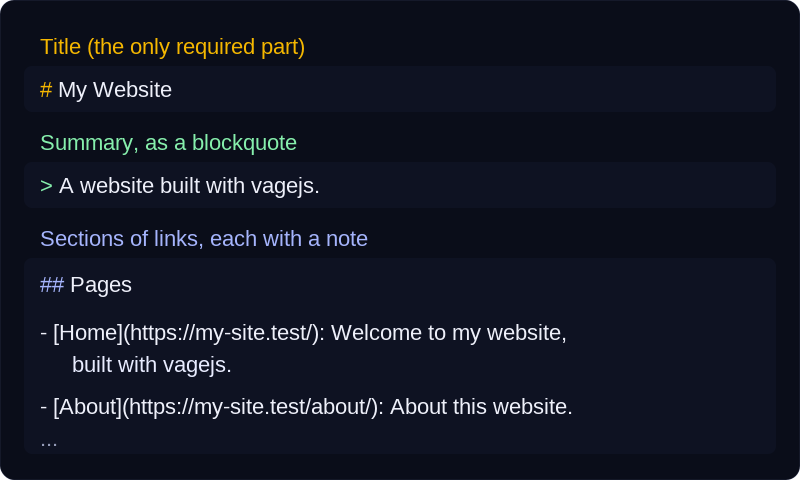
The format is deliberately simple, and only one part is required:
- A title, as a Markdown heading starting with
#. This is the only required section. - A short summary, written as a blockquote (a line starting with
>). - Optional paragraphs with any extra context you think a reader needs.
- Sections of links, each under a
##heading. Every item is a Markdown link, optionally followed by a colon and a short note. - An "Optional" section, by convention, for links a tool can skip when it needs to keep things short.
Here's a real one, generated by vagejs 0.3.0 for a fresh starter site on 24 October 2026 (the site address is a placeholder):
The proposal also suggests something that's arguably more useful than the file itself: offering a clean Markdown version of each important page at the same address with .md added (for example /docs/pricing.md). That way a tool can read the words without the menus and layout around them.
How is it different from robots.txt and sitemap.xml?
These three files sit side by side at the root of a site, which makes them easy to confuse. They do different jobs.
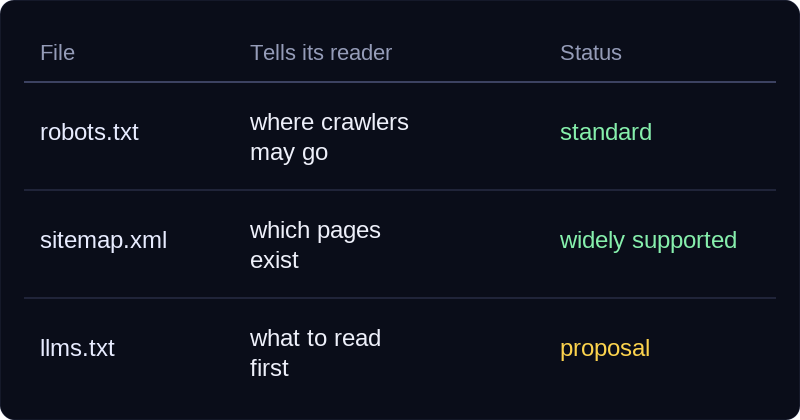
- robots.txt tells crawlers which parts of a site they may visit. It's a long-established convention, written up as an internet standard (RFC 9309) in 2022, and well-behaved crawlers follow it. It's about permission. If you're deciding whether AI companies may crawl you at all, that's a robots.txt question, not an llms.txt one.
- sitemap.xml lists the pages that exist, so search engines can find them. It's about discovery, and the major search engines support it.
- llms.txt describes what's on the site and what to read first. It's about guidance, and it doesn't grant or deny anything. A tool that doesn't know about llms.txt simply never opens it.
An llms.txt file doesn't replace either of the others. The proposal itself presents it as a companion to them.
Who actually reads it?
This is where honesty matters, because a lot of advice online skips it.
Google is clear on its side. Its Search Central documentation on AI features says you don't need to create new machine-readable files or AI text files to appear in them. Normal SEO basics (crawlable pages, good content, a working sitemap) are what count there.
For the AI companies, we read the official crawler documentation from OpenAI, Anthropic and Perplexity while writing this. Those pages explain their crawlers and how robots.txt controls them. None of them, as of this writing, says the crawlers use llms.txt. That doesn't mean no tool ever reads it; it means you shouldn't count on any particular product doing so.
Where llms.txt does get used is closer to home. Some documentation sites publish one so developers can paste it into an AI assistant, or point a coding tool at it, to get accurate answers about a library. Plugins for popular CMSs have started offering it too: Yoast describes an llms.txt feature that generates the file for you.
So, do you need one?
Probably not need. But it's cheap, and for some sites it's handy. A quick way to decide:
Worth it when:
- You run documentation, an API, a developer tool or a knowledge base, and people already use AI assistants to ask about it.
- Your tool can generate it automatically, so it stays in sync as pages come and go.
- You also publish Markdown copies of your pages, which helps any tool reading them.
Don't bother (or don't worry) when:
- You'd have to write and update it by hand and nobody will remember to. A stale list of links that point to deleted pages is worse than none.
- You were hoping it would improve rankings or get you mentioned in AI answers. It won't do that on its own, and nobody can promise that it will.
Two cautions either way. The file is public, so never list private or unpublished pages in it. And if your main concern is controlling access by AI crawlers, llms.txt is the wrong tool; that's what robots.txt is for.
How vagejs handles llms.txt
We make vagejs, a static site generator, so here's how our own tool treats this file. vagejs writes llms.txt on every build by default, using the site title and description from vage.config.ts and the title and description of each page. That's the file in the picture above. If the site has no title, the build skips it and tells you why.
It only lists pages that are meant to be found: drafts aren't built at all, and pages marked noindex or pointing their canonical URL elsewhere are left out, the same rules it uses for sitemap.xml. So the file stays in sync with the site without anyone editing it.
Two options go further:
// vage.config.ts
seo: {
  llmsTxt: { full: true },  // also write llms-full.txt with the text of every listed page
  markdownCopies: true,     // publish /about.md next to /about/, and so on
},
With markdownCopies on, each listed page gets a Markdown copy (for example /about.md for /about/), the page links to it with a rel="alternate" tag, and llms.txt points at the Markdown copies instead of the HTML pages. That follows the proposal's idea of clean Markdown versions. If you'd rather not publish the file at all, set llmsTxt: false. The SEO and AI search docs have the details, and npx vage guidelines shows the source vagejs uses for the format.
What vagejs can't do is make any AI tool read the file, rank you higher or cite you. Nothing can promise that. It just makes the file correct and up to date, at no cost to you.
llms.txt in five points
- llms.txt is a Markdown file at
/llms.txtthat summarizes your site and lists key pages for AI tools. - It's a 2024 proposal, not an official standard, and it's designed for AI tools fetching information on demand, not for search rankings.
- Google says you don't need special AI files to appear in its AI features, and the big AI crawler docs don't mention llms.txt.
- It's most useful for docs and developer sites, and only worth it if it stays accurate, which means generating it.
- It doesn't control access. That's robots.txt's job.
If you're tidying up the rest of your site's search basics, our technical SEO checklist covers the files and tags that matter more.