On this page
You've seen it even if you didn't know its name: asterisks around a word in a chat message, a # at the start of a line in a README, an AI assistant's answer full of bullet points and bold text. That's Markdown. It's a way of writing formatted text using ordinary keyboard characters, and once you know a dozen symbols you can write a whole website with it.
This guide covers what Markdown is, the syntax you'll actually use, the different "flavors" you'll run into, and the small mistakes that catch almost everyone at first.
What is Markdown, and why did it catch on?
Markdown was created by John Gruber in 2004 with a simple goal: text that's easy to read as plain text, and that a program can turn into clean HTML (the code web pages are made of). Compare these two ways of writing the same sentence:
<p>Our shop is open <strong>every day</strong>. See <a href="/hours/">opening hours</a>.</p>Our shop is open **every day**. See [opening hours](/hours/).The second one is readable even if you've never seen Markdown. That's the whole idea.
A few reasons it's everywhere now:
- It's just text. A Markdown file opens in any editor on any computer, now and in twenty years. No special app, no lock-in.
- It keeps writing separate from design. You write headings, paragraphs and lists. The website's templates decide fonts, colors and spacing. Nobody can accidentally make one paragraph bright purple.
- It works with version control. Because it's plain text, tools like Git can show exactly which words changed between two versions of a page.
- AI assistants speak it fluently. Many chat assistants format their replies in Markdown, and coding assistants read and write Markdown files all day.
The syntax you'll use every day
You don't need to memorize everything. These cover nearly all real-world writing.
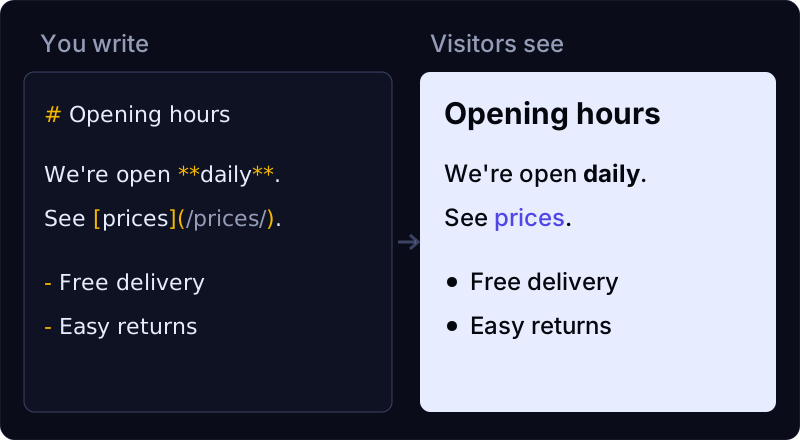
Headings start with #. One # is the main title of the page, two is a section, three is a subsection:
# Our services
## Website design
### What's included
Paragraphs are just lines of text separated by a blank line. A single line break inside a paragraph usually doesn't start a new paragraph; you need the empty line.
Bold and italic use asterisks: **bold** and *italic*. Underscores work too (__bold__, _italic_), but pick one style and stick to it.
Links put the text in square brackets and the address in round brackets: [our prices](/pricing/). For another website, use the full address: [Node.js](https://nodejs.org/).
Images look like links with an exclamation mark in front: . The text in the brackets is the alt text: what a screen reader says aloud to someone who can't see the picture, and what shows if the image fails to load. Describe what's in the picture, not "image" or "photo".
Lists start each line with - (or *) for bullets, or 1. for numbered steps:
- Free delivery
- 30-day returns

1. Choose a size
2. Add to basket
Quotes start with >. Code goes in backticks: one backtick for a word like npm install, three backticks on their own lines to fence off a whole block. A line with just --- draws a horizontal rule (a divider line).
Tables, and why "flavors" exist
Gruber's original Markdown was deliberately small. It had no tables, for example. Over the years, different tools added their own extras, and small differences crept in: one tool treated an edge case one way, another tool another way.
Two efforts tidied this up. CommonMark is a detailed specification that pins down how standard Markdown should behave, so the same file renders the same way in different tools. GitHub Flavored Markdown (often shortened to GFM) builds on CommonMark and adds extras like tables, strikethrough and links that turn clickable on their own. GitHub's guide to basic writing and formatting syntax is a friendly reference.
A table in GFM looks like this:
| Day      | Hours   |
| -------- | ------- |
| Weekdays | 9 to 5  |
| Saturday | 10 to 2 |
The pipes don't need to line up perfectly; that's just for your own eyes. Each row needs the same number of columns, and the second line (the dashes) tells the program "the line above is the header."
The practical lesson: check which flavor your tool uses. The basics (headings, emphasis, links, lists) work almost everywhere. Extras like tables, footnotes and task-list checkboxes vary from tool to tool.
Frontmatter: the details about the page
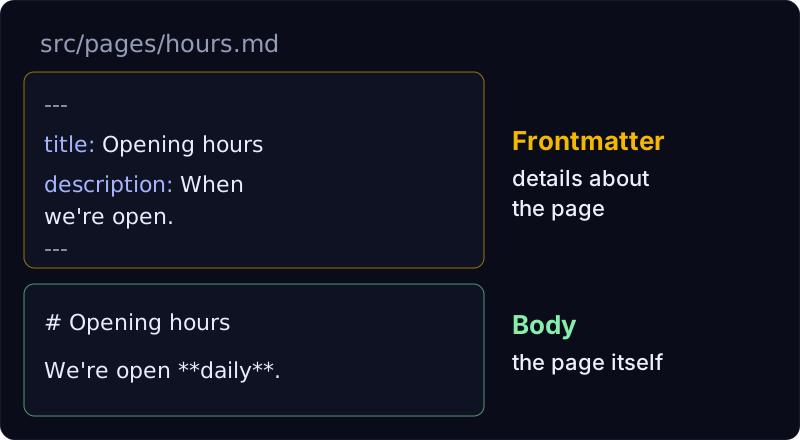
Most website tools that use Markdown add a small block at the very top of each file, between two lines of ---. It's called frontmatter, and it isn't part of Markdown itself. It holds details about the page rather than the page's text: its title, a short description for search results, the date it was published.
---
title: Opening hours
description: When our shop is open, including holidays.
datePublished: 2026-11-27
---
Frontmatter is usually written in YAML, a format of name: value pairs. Two things trip people up. First, the spacing after the colon matters. Second, if a value contains a colon itself (like a title "Markdown: a guide"), wrap it in quotes so the program doesn't get confused.
Mistakes almost everyone makes once
- Forgetting the blank line. A list or heading directly under a paragraph, with no empty line between them, can get swallowed into the paragraph in some tools. When in doubt, add a blank line.
- Skipping heading levels. Jumping from
#straight to###because the smaller text "looks right." Headings are structure, not font sizes. Screen readers and search engines use them as an outline, so go in order. - More than one
#title. Most pages should have exactly one top-level heading. - Empty or lazy alt text.
helps nobody. Say what the photo shows. - Spaces in link addresses.
[menu](/our menu/)breaks. Use hyphens in file and page names:/our-menu/. - Pasting from a word processor. Curly quotes are fine, but pasted text can bring hidden formatting or odd characters along. Paste as plain text.
- Reaching for HTML to change how things look. Most Markdown tools let you mix in raw HTML, but styling one paragraph by hand is exactly the kind of thing that makes a site inconsistent later. Ask for a layout change instead.
Markdown in vagejs
We make vagejs, a static site generator, so this is where Markdown meets our own tool. In a vagejs site every page is a Markdown file in src/pages/, with frontmatter at the top. title is required, and description becomes the page's meta description (which search engines may show under your link), its social preview text and its summary in the site's llms.txt. The content authoring docs list every field.
vagejs reads Markdown with GitHub Flavored Markdown turned on. We checked what that means in practice by building a test page with vagejs 0.3.0 on 24 October 2026:
- Tables, strikethrough and bare web addresses all came out as proper HTML.
- Task-list checkboxes (
- [ ]and- [x]) did not: the list items stayed, but the checkboxes were removed. That's the safety filter at work, because it strips form elements from page content. If you need checkboxes, use plain bullets with words like "Done". - Raw HTML is cleaned before it's published. A
<script>tag, anonclickattribute and astyle="..."attribute were all removed, while the paragraph text stayed. Inline styles are off by default because they're a common way to hide spam links; styling belongs in layouts.
A few checks catch the mistakes from the list above. npx vage check warns when a page has no <h1> heading or ends up with no description at all, and fails on broken internal links and on images with no alt attribute. Images you add with Markdown get their width and height filled in from the file, so the page doesn't jump while loading. See checks and audits for the full list.
What it won't do: it won't judge whether your alt text is any good, and it won't fix a skipped heading level. Those are still on you, or on whoever reviews the page.
The Markdown basics to remember
- Markdown is plain text with a few symbols:
#for headings,**for bold,[text](address)for links,for images,-for lists. - The basics work everywhere. Extras like tables and checkboxes depend on the tool's flavor, so check yours.
- Frontmatter at the top holds details about the page, like its title and description, and isn't Markdown itself.
- Use blank lines generously, keep headings in order, and write real alt text.
If you'd like to put this into practice, getting started walks you from an empty folder to your first page, and our post on fast websites without JavaScript explains why plain pages like these load so quickly.